
Why Learning Feels Hard (And Why That's Often a Good Sign)

If you've ever sat beside your child during homework and watched their confidence unravel in real time, you know how uncomfortable that is to witness.
One minute they're working steadily. The next they're saying things like:
"I don't get it."
"I'm stupid."
"I can't do this."
The instinct is to step in, explain the answer, or reassure them. But what if that moment of struggle isn't a sign that something has gone wrong?
What if it's actually a sign that learning is happening?
Learning Isn’t Supposed to Feel Easy
Many children grow up believing that they are supposed to understand everything they learn straight away. So when they hit a wall, they often land on one of two conclusions: they're not smart enough, or they're failing.
Neither is true.
Real learning requires the brain to grapple with new ideas, make mistakes, test different approaches and build new connections. That process can feel uncomfortable.
Educational research suggests that confusion can be an important part of learning. When children encounter ideas that challenge their current understanding, they need time to question, test and reorganise what they know before deeper understanding develops.
The Learning Pit
One model that helps explain this is the Learning Pit, developed by educational consultant James Nottingham.
The idea is simple: learning often becomes most uncomfortable just before understanding develops. When children move beyond what they already know, they enter a period of uncertainty where old strategies stop working but new understanding hasn't formed yet.
That uncomfortable middle stage is the pit.
The important thing to understand is that the pit is a normal part of the learning process. In fact, it's often where the most valuable part of learning takes place.
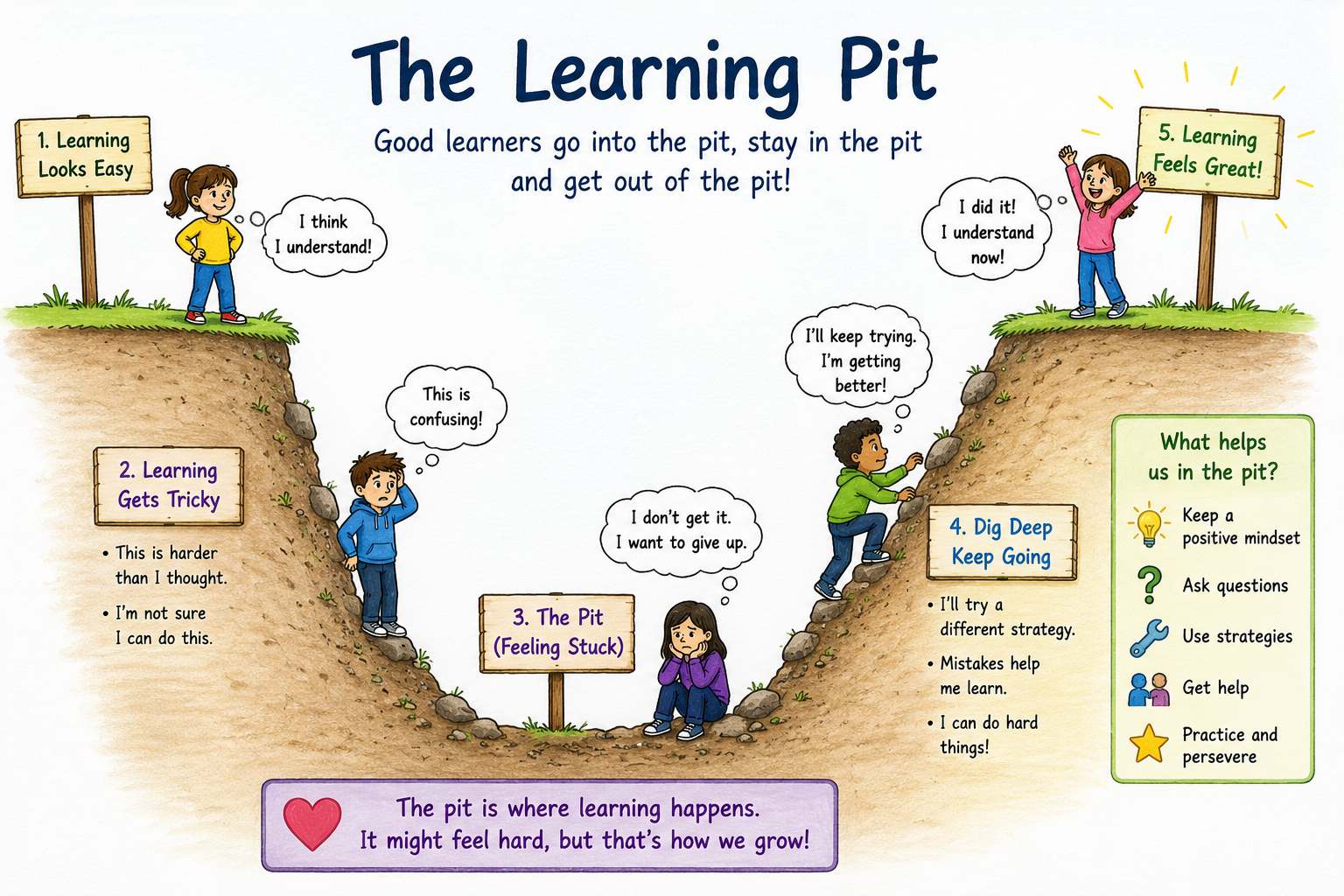
Stage 1: The comfortable beginning
At the start, children feel confident. They're working with familiar ideas and success comes easily. It feels good, but very little new learning is actually happening here.
Stage 2: Entering the pit
Then the challenge increases. Maybe a maths problem adds an extra step. Maybe a reading task asks for a deeper level of thinking. The strategies that worked before suddenly aren't enough, and certainty disappears.
This is where confusion sets in, and where many children start to struggle emotionally.
Stage 3: The bottom of the pit
This is the stage parents often find most concerning.
Children can't yet solve the problem, but they can no longer rely on what they already knew. They're in the messy middle, and it can feel, and look, a lot like failure.
It isn't. The brain is actively trying to make sense of new information and build stronger understanding. This is often the point where children are comparing ideas, spotting misconceptions and making the mental connections that lead to deeper learning.
Stage 4: Climbing out
With time, guidance and persistence, children begin connecting the pieces. They test ideas, make mistakes and refine their thinking. The climb out is rarely dramatic, it's usually slow and uneven. But every attempt strengthens the learning.
Stage 5: The "aha" moment
Eventually it clicks. And because they worked through the challenge themselves, that understanding tends to stick in a way that a quick explanation rarely achieves.
What Can Parents Do?

The first step is recognising that struggle isn't always a problem that needs fixing. Sometimes it's evidence that your child is being appropriately challenged.
Rather than jumping straight to answers, try asking:
What part do you understand so far?
What have you already tried?
Where did it stop making sense?
Is there another way we could approach this?
These questions keep children engaged in the thinking rather than waiting to be rescued.
When Struggle Is Productive and When It Isn't
Not all struggle is useful, and it's worth knowing the difference.
Productive struggle usually looks like effort and persistence, trying different strategies, asking questions and gradual progress over time, even if the child feels frustrated.
Unproductive struggle looks different: complete shutdown, repeated confusion over the same concept despite ongoing effort, or significant anxiety that's getting in the way rather than simply accompanying the work.
In those situations, a child may need additional support, clearer instruction or a different approach. The goal isn't to leave children floundering, it's to give them enough support that they can climb back out.
The Next Time Learning Feels Hard
Difficulty isn't always a warning sign.
Sometimes it's evidence that your child's brain is doing exactly what it's supposed to do. Learning is messy and uncomfortable, and that's often where growth happens.
So the next time your child says, "I can't do this," remember that learning isn't always supposed to feel easy. Sometimes the frustration, confusion and uncertainty are signs that they're stretching beyond what they already know.
The challenge isn't avoiding the pit. The challenge is helping children develop the confidence and support they need to keep moving through it.
At Attain Education, our qualified primary teachers help children work through challenges in a calm, supportive environment, building both skills and the confidence to keep going when learning feels hard. Book your free consultation call today with one of our experienced tutors and find out how we can support your child.