

Does your child breeze through basic maths questions, only to get completely stuck when those same skills appear in a word problem?
The problem isn't necessarily their maths skills. It's knowing how to turn a question written in words into a maths problem they can actually solve.
Word problems ask children to do several things at once. They need to read and understand the question, identify the important information, decide which mathematical operations to use and then work through the calculations.
That's a lot to juggle!
The good news? Problem-solving is a skill that can be taught and practised. And one of the best ways to help children become confident problem-solvers is to give them a simple process they can follow every time.
1. Highlight or Underline the Key Information
Before reaching for a calculator or writing down an equation, children need to understand what the question is telling them.
Encourage your child to read the problem carefully and highlight or underline the important information.
For example:
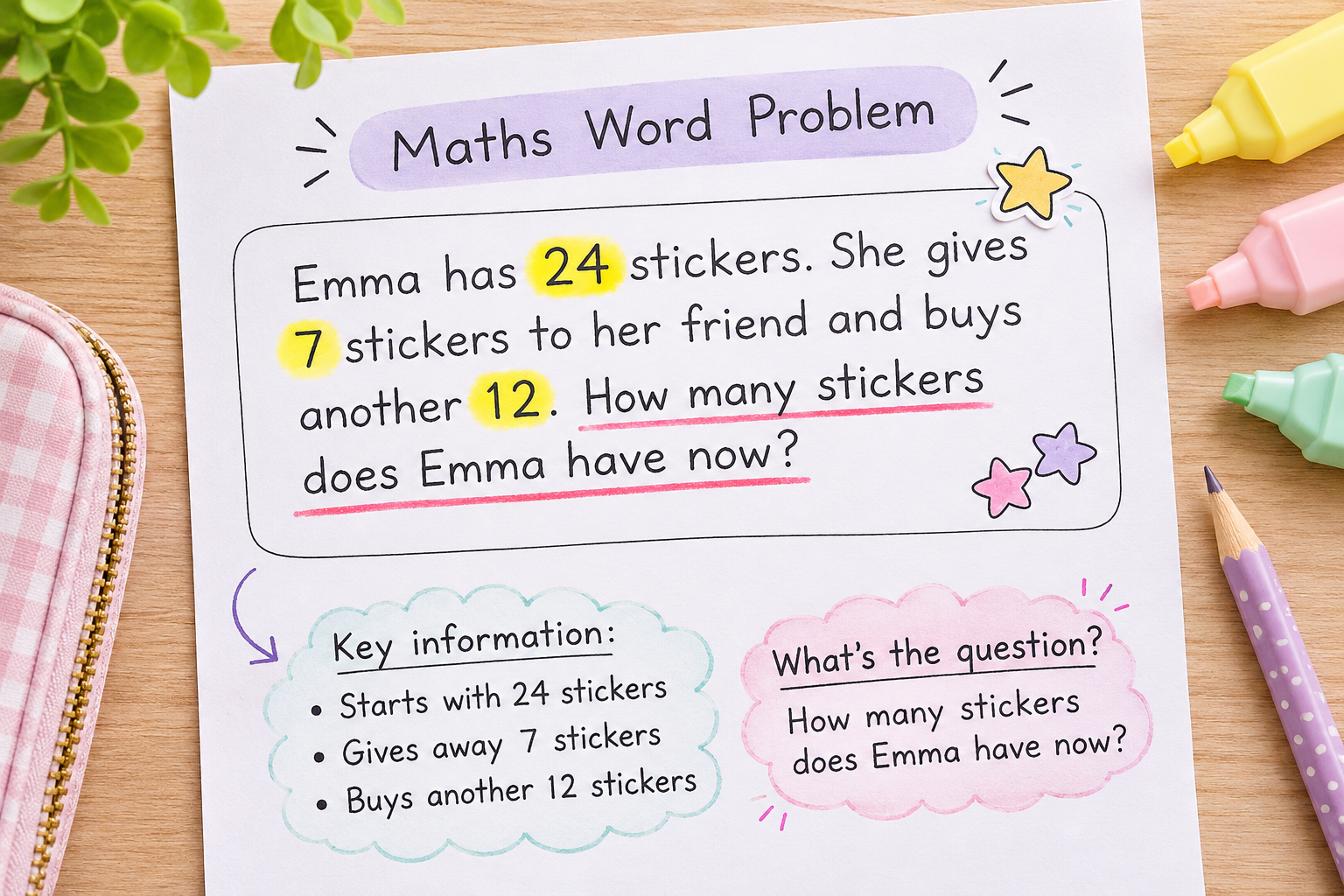
Emma has 24 stickers. She gives 7 stickers to her friend and buys another 12. How many stickers does she have now?
The important information includes:
Emma starts with 24 stickers
she gives away 7
she buys another 12.
Highlighting helps children focus on the details that matter without getting distracted by the story around them.
Just remember, not every number in a word problem is necessarily needed. Part of the skill is learning to recognise which information is relevant.
2. . Find the Question You're Being Asked to Answer
One of the most common mistakes children make is starting their calculations before they've worked out what they're being asked to find.
That's why we encourage children to pay particular attention to the final sentence, which often contains the actual question.
In our sticker example, the question is:
How many stickers does Emma have now?
This tells us we're looking for the number of stickers Emma has after both changes.
A helpful habit is to ask your child:
"What is this question actually asking you to find out?"
If they can explain the question in their own words, they're already making progress towards solving it.
3. Show Your Working Out
Mental maths is a fantastic skill, but when word problems become more complicated, trying to hold everything in your head can make things harder.
Encourage your child to write down each step.
For Emma's stickers, that might look like:
24 − 7 = 17
17 + 12 = 29
Emma has 29 stickers.
Showing working out isn't just about getting marks at school. It helps children organise their thinking and makes it much easier to spot mistakes.
It also gives them something to look back at if they need to check their answer.
And working out doesn't always have to mean equations! Drawing pictures, using number lines or creating simple diagrams can be equally valuable ways to make sense of a problem.
4. Use Checking Strategies, Including Inverse Operations
Getting an answer doesn't mean the problem-solving process is finished!
Children need to develop the habit of checking their work rather than assuming their first answer must be correct.
One useful checking strategy is to use inverse operations, which simply means using the opposite operation to check a calculation.
For example:
If 24 − 7 = 17, we can check by calculating 17 + 7 = 24.
If the numbers don't match, it's a sign that something needs another look.
Children can also reread the question and check whether they've completed every step.
In our sticker example, a child might correctly calculate 24 − 7 = 17 but forget that Emma bought another 12 stickers.
Checking the original question helps catch that mistake.
The goal isn't to make children afraid of getting things wrong. It's to help them recognise that checking and correcting are normal parts of maths.
5. Estimate First to See if Your Answer Is Reasonable

Before working through a problem, ask your child to make a rough estimate of what the answer might be.
For example, if a question asks them to calculate 198 + 304, they could round the numbers to 200 and 300.
That gives an estimate of about 500.
If their final answer is 5,020, they'll know something has probably gone wrong!
Estimating doesn't need to produce an exact answer. Its purpose is to give children a sense of what a reasonable result looks like.
It also helps them develop number sense, which is an important foundation for confident maths learning.
Building Confident Maths Problem-Solvers
Word problems can feel overwhelming, especially for children who already find maths challenging.
But with a clear process to follow, even tricky questions become more manageable.
Remember these five steps: highlight the important information, identify the question, show your working, check your calculations and estimate whether the answer makes sense.
With practice, these strategies can become habits that help children approach unfamiliar problems with greater independence and confidence.
At Attain Education, our qualified primary teachers help children build the skills and confidence they need to tackle maths challenges. Book your free consultation call today and let’s talk about how we can help your child become a more confident problem-solver..