
What Australian Teachers Say About Supporting Struggling Students

We Asked Australian Teachers What Helps When a Child Is Struggling. The Results Were Pretty Clear.
When your child is struggling at school, it can be hard to know what kind of help they actually need.
More practice at home? An educational program? Extra support at school? Tutoring?
There are plenty of options, and plenty of opinions about which one is best.
So we decided to ask the people who work with children and their learning every day.
We ran two informal polls across Australian primary teacher Facebook groups, asking teachers about the support they find most helpful for students who are struggling.
The consistency of their responses caught our attention.
Teachers Want More Time to Help
Our first poll asked:
When a student is really struggling, which type of 1:1 support do you find most helpful for them?
We shared the poll in six Australian teacher groups. In four of the six groups, the most popular response was:
“I’d love to give more 1:1, but realistically my current class size limits this.”
In the other two groups, teachers most commonly chose an in-school learning support teacher providing extra 1:1 time.
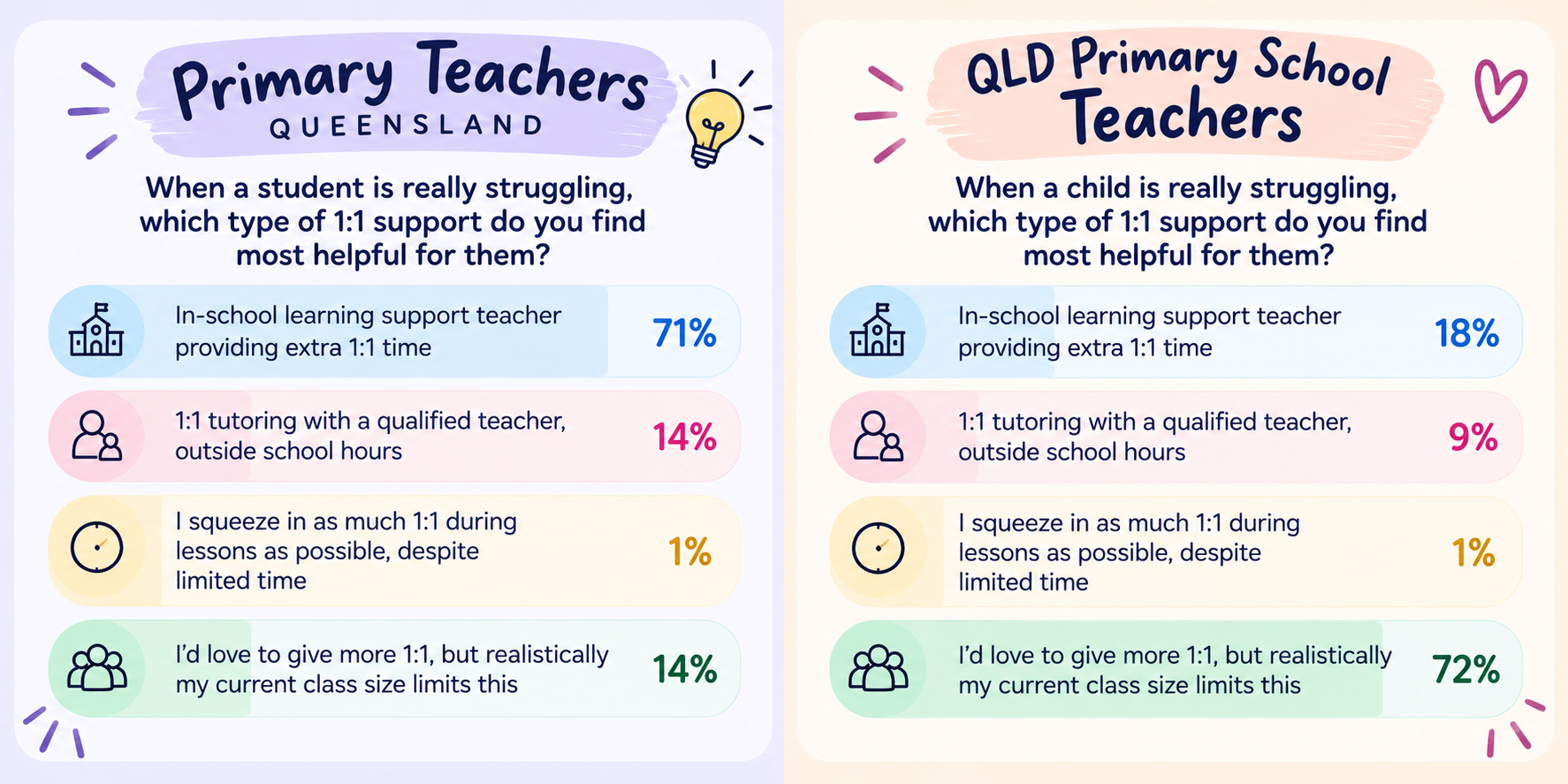
Poll results from Primary Teachers Queensland and QLD Primary School Teachers Facebook groups.
The message was pretty clear. Teachers value individual support, but there is only so much one-to-one time available in a busy classroom.
A teacher can know exactly which children need extra help and still struggle to find enough uninterrupted time to work individually with each of them. With an entire classroom of learners needing their attention, that dedicated one-to-one time can be difficult to come by.
So What Do Teachers Think Is the Best Extra Support?
That led us to our second poll:
If students are struggling with their learning, what do you believe is the most effective avenue to help them?
Teachers could choose one-to-one tutoring with a teacher, parent-led extra homework, small group sessions with a teacher aide at school or self-directed learning programs such as Reading Eggs or Mathseeds.
This time, the result was remarkably consistent.
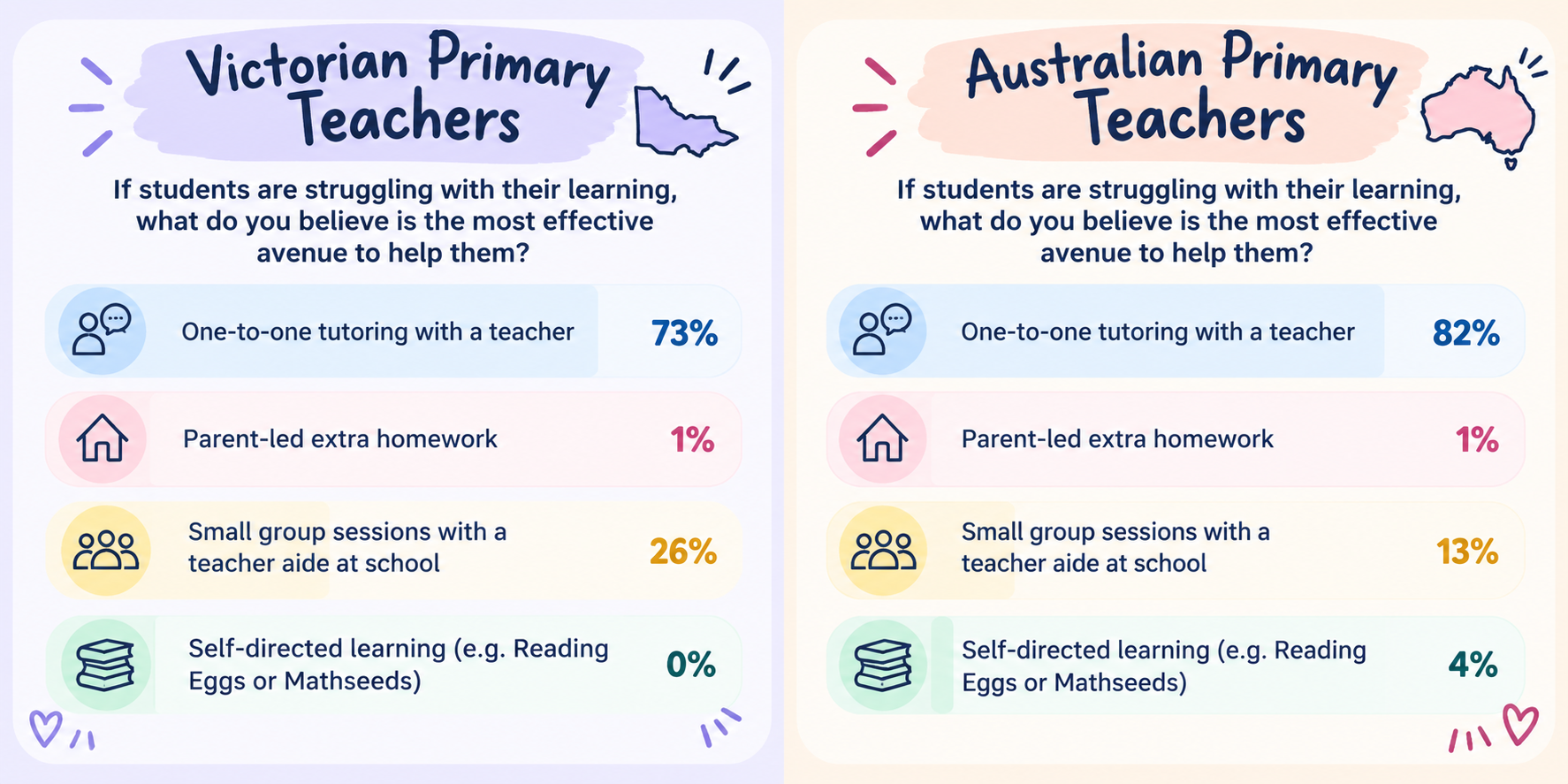
Poll results from Victorian Primary Teachers and Australian Primary Teachers Facebook groups.
Across all six teacher groups, one-to-one tutoring with a teacher was the clear first choice.
Between 73% and 82% of respondents in each group selected it.
Small group sessions with a teacher aide generally came in second. Parent-led extra homework received between 0% and 1% and self-directed programs received only a small proportion of responses.
Why One-to-One Teacher Support Helps
The advantage of one-to-one teaching is not simply having someone sit beside your child while they work.
A qualified teacher can pinpoint the moment learning starts to get fuzzy. They can work backwards to find the missing piece, then use different teaching methods, games and exercises until the concept makes sense and the foundation is solid.
That might mean slowing down, explaining something in a completely different way or stepping back to an earlier skill before moving forward again.
And because they are working one-to-one, they can focus completely on the child in front of them and adjust as they go.
That level of individual attention is much harder to provide consistently when one teacher is responsible for an entire classroom.
Tutoring can add something different to the support a child already receives at school: dedicated teacher time to strengthen the foundations and help learning click.
You Don’t Have to Become Your Child’s Teacher
One result from our second poll was especially interesting for parents.
When you realise your child is struggling, your first instinct might be to give them some extra attention at home. More practice, more reading, maybe a few extra worksheets. It makes sense. You can see they need help, so of course you want to do something.
But almost nobody in our teacher polls chose parent-led extra homework as the most effective avenue of support.
That doesn’t mean parents don’t have an important role in learning. It means you don’t have to know how to teach every concept your child finds difficult.
Sometimes the best way to support your child is to recognise when they need extra help and find the right person to provide it.
When a Child Needs More Time With a Teacher
Taken together, the two polls tell a simple story.
Teachers value individual support. Many say class size limits how much one-to-one time they can give. And when we asked which avenue they believed was most effective for a struggling student, one-to-one tutoring with a teacher came out clearly ahead.
Thank You to the Teachers Who Took Part
A big thank you to the teachers who voted and shared their thoughts in the Australian primary teacher Facebook groups where we ran our polls: Australia Primary Teachers, Australian Primary Teachers, Brisbane Teachers, Primary Teachers Queensland, QLD Primary School Teachers, Queensland Primary School Teachers, QLD Primary Teachers, QLD Teachers and Victorian Primary Teachers.
We’re grateful to every teacher who took the time to contribute.
At Attain Education, all of our tutors are qualified primary teachers who understand how children learn and how to help when they’re struggling. Book your free consultation call today and let’s talk about how personalised tutoring could support your child’s learning needs.